Showing posts with label facebook. Show all posts

Facebook Advertising | Should My Company Advertise on Facebook

Should My Company Be Advertising on Facebook


Facebook Advertising
Facebook ads have been around for a little while now but people are still unsure if they should be including them in their internet marketing strategies.

This webinar will give you an overview of Facebook Ads to help you decide if they are good fit for your business. We will cover:

  • The differences between Facebook Ads and Google Adwords, Google's online advertising platform
  • The pros and cons of using Facebook Ads
  • How to create the ads and target the right demographic

Internet marketing video

Presented by Jenika Scott of Hall Internet Marketing Solutions


Should My Company Be Advertising on Facebook? from Hall Internet Marketing on Vimeo.

Additional Resources on Facebook Articles and Videos


- Facebook Wedding Pages

- Facebook SEO Tips

- Create Facebook Landing Page HTML iFrame Edition

- Build Your Brand with Facebook

- How to Make a Facebook Like Page

- Facebook Nabs Nearly One-Third of Display Ad Market

- How To Attract Fans To Facebook Fan Page

Be a buddy - Share this with your friends...click on a button now.


How To Build Your Brand with Facebook

Facebook Fans

How To: Build Your Brand with Facebook

The Link Between Wall Posts and Product Loyalty


Emma  Johnson 

You’ve got a solid company and a winning brand. Do you really need to get wrapped up in the Facebook craze? What’s the big deal, anyway?


“Facebook offers a free booth at the world’s largest tradeshow with 600 million visitors, so why not be there?” says Jennifer Abernethy, a sales and marketing consultant and author of The Complete Idiot’s Guide to Social Media Marketing.

“This is a business revolution that is taking place right now, and it is good to have a presence there.”

The key is to identify your target audience, develop an authentic voice, and keep an open mind as the technology and your Facebook presence evolves. “We don’t know what Facebook will look like in two years,” Abernethy says. “But it is never too late to jump on the bandwagon.”


Who, What and How Often?


While you may feel the urge to jump in feet first to compete with company pages with millions of fans, the key is to take your time and develop a strategy that you can build slowly, says Michael Bird, president of Des Moines, Iowa, social media consultancy Spindustry.

Be Creative to Build Your Brand
A large number of fans is less important than a few fully-engaged fans. “Take some time to develop your voice and to focus on the audience who will use that brand,” Bird says.

For example, just because you have three product lines does not mean you automatically need three Facebook pages.

Instead, determine who uses your products and create a page that focuses on them.

It is essential to figure out who this target audience is and how to communicate with those people. Are they busy moms? Single urban guys? Broke college students? No matter who your target customers are, talk to them like they’re real people.

“They don’t care about your product lines or corporate language,” Bird says. “People have an inherent cynicism about the corporate veil.

The whole idea behind social media is giving people a peek behind that veil. You have to be informal and authentic, and engage in a way that encourages two-way communication.

People like to share things they’re passionate about, just as long as they’re sharing news they’re proud of.”

It will take trial and error, but post not only about your product news, but headlines, insider tips and contests that appeal to your target audience. “Facebook can help broaden the definition of what your company does,” Bird says.

For example, an athletic shoe store might post a video about post-workout stretches—positioning the sales team as physical fitness experts, not just pushy peddlers.

Post at least once per week, but aim for several times weekly. In the initial months of your site, it helps if readers have something to look forward to—say, tips on Tuesdays and new recipes on Fridays. But it is important to stay nimble enough to spontaneously react to relevant headlines and commentary.
Facebook Branding Rules


Rules of Engagement


Kinks and challenges will no doubt present themselves. A couple guidelines to live by include:

⇒  Embrace customer support issues. If fans post their complaints on the wall, use it as an opportunity to showcase your service team and commitment to resolving problems. “A negative message dealt with well is better than one not raised at all,” Bird says.

⇒  Remove off-the-wall wall posts with care.
 Truly offensive or inappropriate comments should be deleted, while those that are simply out of line ought to be responded to professionally. “If they’re making a statement of mistake, correct them and disengage,” Bird advises, but deleting is a stickier matter. “You potentially break the authentication of your site if you delete a post,” he says. A good rule of thumb is that if the comment were made aloud in a town hall meeting, would the police escort the messenger out? “If the answer is yes, deleting is appropriate,” Bird says.

To continue reading this article and two case studies click on this lin....How To: Build Your Brand with Facebook | SUCCESS Magazine | What Achievers Read

Additional Reading and Videos on Facebook and Social Media

After the video below you will find related articles and more video tutorials on soical media on this blog.  The video below is called - 10 Simple Ways To Increase Your Brand On Facebook.


- Social Media for Marketing Video Training Bootcamp

- Video Webinar How Social Media Is Impacting Search

- Video - Social Media Success In 4 Steps

- How to Make a Facebook Like Page

- Face Book Advertising

Share this with your friends...click on a button now.


Face Book Advertising

Facebook Advertising Founder

Face Book Advertising


So you want to advertise on Facebook. Well, here's the Nitty-gritty on Face book advertising in today's market.

Facebook is in almost every home in the United States and around the world. There are more than 500 million users on Facebook that see Facebook advertising every day.

Facebook ads and Google AdSense work much the same way. They both use Pay Per Click ads. But there are some differences though.

With Facebook you can narrow your ads to any specific demographic.

If you want only men between the ages of 25-30 to see your ad, there’s an app for that. You can also choose by location and interest.

With Facebook advertising, targeting keywords is optional because ads are delivered directly to the target audience on their fan pages and news streams pages.

Advertising on Facebook
Another benefit of using Facebook advertising is that there are fewer advertisers competing with you. This will cost you significantly less with a pay per click campaign giving you a higher ROI.

The best part is when people “Like” your advertisements because that goes straight to their friends’ news streams giving your ad more exposure.

There have been very successful ads that have gone viral on Facebook.

In this article I will walk you through the five steps necessary to plan and benefit from Facebook Advertising.

The steps I’ll talk about are these:
  1. What Are Your Goals?
  2. Who is Your Audience?
  3. Design Your Advertisement
  4. Establish Your Budget and Pricing
  5. Track the Data!
Let’s start working.

What Are Your Goals for Advertising on Facebook?

The first step to a positive Facebook advertising campaign is to give some thought as to what you want to accomplish. What do you want to do exactly?

Is it:
  • Drive traffic to a website or blog
  • Drive traffic to your Facebook Like page or Fan page
  • Purchase leads
  • Augment sales for a product or service
  • Generate awareness and increase brand exposure
You may want to focus on all of these goals and I don’t blame you. Who wouldn’t?

But it is belter to be specific. This will help you produce the
Facebook People to Advertise
most successful ad possible.

It’ll also help you make the right decisions when establishing your budget and choosing your audience specifications.

Who are the people that you want to advertise to on Facebook?

One of the great things about Facebook advertising is that you can be incredibly targeted.

Remember when you signed up for a Facebook account? They asked you a lot of questions such as, who are your favorite sports teams and rock stars.

They even asked you what books you were reading.

It is this information that Facebook uses when targeting your ad. You can get as targeted as you need to in order to reach your potential customers.

Say, for example, you want to target women in the age range of 40-50 who live in the state of Ohio. You can do that on Facebook. They have that information.

Design Your Advertisement

There are four elements to every Facebook advertisement and you will have to make decisions on the kind of information that you want each element to contain.

They are:
  1. The website address of where you want to drive the traffic to when a person clicks on your ad. Where do you want them to go? A sales page? An opt-in page? Your fan page?

  2. Headline - on Facebook your headline is limited to 25 characters, counting spaces.

  3. Ad text – This is where you include a call to action. You have 135 characters to achieve this goal.

  4. A graphic – choose an image that relates to your business. The maximum image size is 110 pixels wide by 80 pixels tall.

Facebook Advertisement Budget

Advertisement Budget
After you have created your ad and picked your target market you’ll be asked to set your budget and pricing.

Here are the decisions you’ll have to make:

Pricing Type


There are two different pricing types on Facebook. They include:

Cost Per Click (CPC) - A type of campaign pricing where you pay each time someone clicks on your ad.

Cost Per Thousand Impressions (CPM) - A type of campaign pricing where you pay based on the number of people who view your ad.

Daily Advertising Budget


Your daily budget is the highest amount of money you're willing to apply on an individual campaign each day.

Tracking Your Data


Facebook offers analytics and data information so that you can test and track almost every aspect of your campaign.  You will know which ads are getting the best result and then duplicate the process.

Okay, now you know the basic steps required to achieve success with Facebook advertising.

Listed below are some social media training videos and articles.

Click on one of the links below now.

- How to Make a Facebook Like Page

- Facebook Nabs Nearly One-Third of Display Ad Market

- How To Profit On Social Media Networks Video Course

Be a buddy - share this with your friends...click on a button now.


Nine SEO Blogging Tips for Creating Blog Posts

Optimize Your Blog

Nine SEO Blogging Tips for Creating Blog Posts


These nine SEO blogging tips were originally published by Mequoda.com.

Blogging tips can help educate you in how to gain a higher ranking in search engine results which will help drive traffic to your blog.

One thing Google’s Panda update has taught us is that quality content is a clear focus on their indexing process.

Beyond quality content, we’ve seen specific techniques for placing content within web pages that has helped achieve the three primary concepts behind effective content marketing:
  1. content
  2. community
  3. commerce
Nine components for article optimization

These techniques show exactly where keywords should be placed and components that should be included within each article you publish.

The following list will help you create engaging, Google-friendly articles for your target audience.

SEO Blogging Component #1


SEO Blogging
Page Title – The page title needs to carry the main keyword phrases of the article.

Often times, writers make the page title and the headline one in the same, providing their headlines are keyword-optimized.

SEO Blogging Component #2


URL – Keywords should be placed in the URL for added optimization. If your headline is optimized, your URL and headline could be very similar.

SEO Blogging Component #3


Headline – The headline needs to include keyword phrases while remaining relevant to the overall topic.

Some journalists prefer to write catchy headlines and then have difficulty incorporating keyword phrases.

To supply both needs, journalists can publish an article with one title, and then change the title for SEO purposes after the initial publication.

Good Blog Headlines
Intriguing headlines can be created while still including keyword phrases.

How-to articles, numbered lists and fascination headlines can all do this with ease.

The title of this article is a good example of how a numbered list can include a keyword phrase.

In this case, “SEO Blogging” is the main keyword phrase being targeted.

Discover valuable information on link building, keyword strategy, creating free reports and gaining website visibility when you download our FREE SEO Campaign Management Basics white paper.

SEO Blogging Component #4


Subhead – The subhead should include keyword phrases while elaborating on the main content found in the article.

SEO Blogging Component #5


Body Copy – A keyword density around 3.0 should be the goal for articles you’d like to be ranked on. Body copy needs to be engaging, informative and contain multiple paragraphs.

Furthermore, the editorial standard of proper spelling and grammar is a must.

SEO Blogging Component #6


Category – Putting all articles into categories allows audience members to find aligned content easier while consistently receiving additional SEO fodder.

SEO Blogging Component #7


Free Report Link – All articles should point to an aligned free report.

This helps online publishers collect more data from visitors as the free report is given in exchange for a valid email address.

Create Your Blog Category
Having a link to an aligned free report in every post helps affords a better chance of converting casual visitors into registered members.

For instance, if you were reading a post about Internet marketing and were offered a longer, more in-depth report on the topic of interest for free, wouldn’t you act on that opportunity?

SEO Blogging Component #8


Share – To fulfill the criteria of community, adding a share option in every post allows audience members to easily distribute the content to others.

Facebook and Twitter are two of the most popular avenues for sharing content. Plus, a recent SEOmoz study revealed the prevalence Share features have on SEO rankings.

SEO Blogging Component #9


Comment – The Panda update has made user comments more valuable to publishers. Comments are great for community building and help pages rank better within search engines.

If you don’t experience a lot of comments on a normal basis, start conversations within your articles and specifically ask people to comment.

Search Engine Optimization if Free

Search engine optimization is a free, organic method for increasing your website traffic and visibility. For more on SEO, and an array of other methods for increasing website traffic, join us for our 29 Ways to Increase Website Traffic webinar on June 14th.

Did you see the video tutorials How to Optimize Your Website

There's also the article How to Get Traffic to Your Blog Quickly

Ramiro Rodriguez

Be a buddy--share this with your friends...click on a button now.

Facebook Nabs Nearly One-Third of Display Ad Market

Published on May 9, 2011  

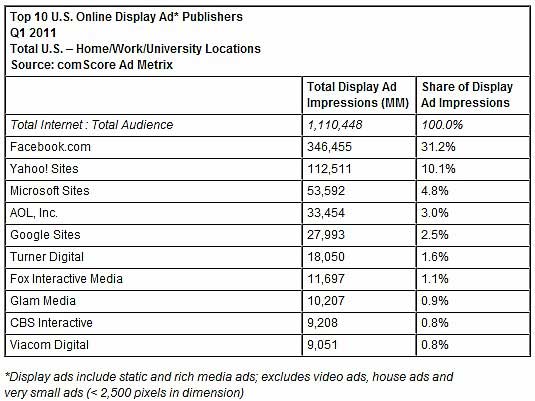
Nearly 1.1 trillion display ad impressions were delivered to US Internet users in the first quarter of 2011; among them, Facebook accounted for 346 billion—31.2% of the total display market—nearly twice the level delivered one year earlier, according to data from comScore Ad Metrix.

Yahoo Sites ranked second with 112 billion impressions (10.1%) during the first quarter, followed by Microsoft Sites with 54 billion impressions (4.8%) and AOL with 33 billion impressions (3.0%).


Google Sites, relatively new to the display ad market, accounted for 2.5% of total impressions during the period.


Looking for great digital marketing data? MarketingProfs reviewed hundreds of research sources to create our most recent Digital Marketing Factbook (May 2010), a 296-page compilation of data and 254 charts, covering email marketing, social media, search engine marketing, e-commerce, and mobile marketing. Also check out The State of Social Media Marketing, a 240-page original research report from MarketingProfs.


AT&T was the top online display advertiser with 19.5 billion impressions in the first quarter, accounting for 1.8% of display ads. Experian Interactive ranked second with 16.6 billion impressions (1.5%), followed by Scottrade with 11.2 billion (1.0%) and Intuit with 11 billion (1.0 %).
Groupon joined the top 10 display advertisers at No. 7 with 7.7 billion impressions (0.7%).


Other key 1Q11 findings:
  • The top advertisers in 1Q11 ranked by estimated share of online display ad spending were: AT&T (2.1%), Experian (1.9%), Scottrade (1.6%), Toyota (1.2%), and Netflix (1.1%). Rounding out the top ten were Intuit, Verizon, Progressive, Sprint Nextel, and ING—each with 1.0%.
  • The top consumer goods advertisers ranked by display ad spending were: Procter & Gamble, Mars, Kellogg’s, General Mills, and Kraft Foods.
  • 95 different advertisers delivered at least 1 billion display ad impressions and 293 advertisers spent at least $1 million on display ads during the quarter.
"The US online display advertising market maintained its strong momentum from last year with a terrific first quarter," said Jeff Hackett, comScore executive vice president.

"We are now seeing more than one trillion display ads delivered every single quarter and nearly 300 individual advertisers spending at least $1 million a quarter on display, numbers which underscore just how large and vibrant the online medium has become. And it's not just about the volume but about the quality of the advertising experience that can be delivered as we see continued investment in compelling, high-quality creative that helps cultivate long-term brand equity."

Read more:

Advertising - Facebook Nabs Nearly One-Third of Display Ad Market : MarketingProfs Article

Did you read the last post How to Use PLR

Let's grow together,

Ramiro Rodriguez

Internet Marketing eBooks

Share my journey click on two buttons below now.


Popular Posts